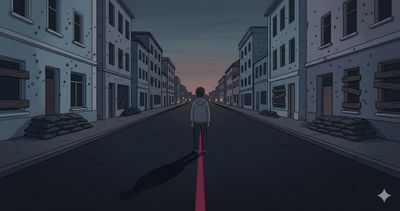
A personal essay on growing up between East and West Beirut, the borrowed name that explained Lebanon better than any history class, and the way the same scar shows up four thousand kilometers north when a German clerk asks Muslim, ja?
My name is Charbel. My mother gave it to me because she saw Saint Charbel appear to her in a dream the night I was born. She took it as a sign. It did not hurt that I was born on Saint George's day, the patron saint who slays the dragon, the saint whose icon hangs in every Christian Lebanese household. And my last name, Wakim, traces back to Joachim, the father of the Virgin Mary. Three saints stacked on one boy before he learned to speak. So here I am, walking through life with a name that announces me before I open my mouth.
That announcement matters more in Lebanon than anywhere else on earth.
The Good Samaritan
I grew up in Achrafieh. If you know Lebanon, you know what that means. My school was Sagesse, in the heart of it, a hyper-Christian institution where we learned more about Jesus than mathematics, more about martyrs than history, sitting in the geographic center of Lebanese Forces territory. It was a world sealed inside itself. There were seven Charbels in my school year. My friends called me Wakim, because yelling "Charbel" in the hallway produced a small crowd.
Then, when I was twelve, something changed. The school opened its doors to everyone. One Muslim student enrolled. His name was Mustafa.
Mustafa had the audacity to sit next to Charbel.
We became friends.
That sounds like the punchline to a joke. It was not. Mustafa was just a kid who liked the same things I liked. He was good company. One afternoon he invited me to hang out at his place in West Beirut. We wanted to go play Counter-Strike at an internet cafe. Mustafa's dad said stay home. We were kids. We begged. He eventually gave in.
Before we left, he pulled me aside at the door. He looked at me and said, quietly: "3amo, when they ask your name, just say Ali."
I did not understand.
To me, we were one Beirut. I had not yet learned that the city had a seam running through the middle of it, invisible to children and drawn in blood by adults. I thought Mustafa's dad was embarrassed by me, or embarrassed by something. I could not name the feeling. I said okay, and we went and played Counter-Strike, and nothing happened, and I never really thought about it again.
Until things started happening.
The Syrian occupation tightened its grip. MTV Lebanon was shut down overnight. Friends were grabbed from inside the school. Rafic Hariri was killed. I was sixteen, in the middle of my bac blanc, when the shockwave shook a window out of its frame and onto my head. Then Gebran Tueni. Then Pierre Gemayel. The fault lines were no longer something you read about. They were something you felt land on you.
That was when "just say Ali" stopped being confusing and became obvious.
Mustafa's dad was not ashamed of me. He was protecting me. He saw a boy with a saint's name walking into a neighborhood that was reading names like threat assessments. He put his hand on my shoulder and gave me the fastest, gentlest piece of armor he had.
The strangest thing is, our fathers were friends. My father, the Christian freedom fighter. Mustafa's father, the Sunni from West Beirut. I remember them at the same dinner table, laughing. I said the Abana at Mustafa's father's funeral. Mustafa read the Fatiha at my father's funeral.
The Contradiction in the House
My father was Lebanese Forces through and through. The same man who told me to never judge a person by their religion would tense up if a stranger asked our family name in the wrong neighborhood.
Every summer he drove me up to Bzebdine, a half Christian half Druze village in the mountains, where I would spend weekends and entire weeks at a friend's house. The friend was also called Charbel, obviously. The village had a Kataeb office that, in my father's words, would "be there if something happened." I think that was the only reason he agreed. Not because he was at peace with it. Because there is no arguing with a stubborn sixteen-year-old who wants to see his friend.
Coming back, there were two ways down. The fast route was tarik sayda, the old Saida road, cutting through Shia neighborhoods on the southern edge of Beirut, deep Hezbollah country. The slower one went the long way around. He always took the long way. Every time I asked why, he gave the same one-word answer. "Safer."
The war was over. The fear was not.
Respect everyone. But be ready for the crusade when faith is touched.
I did not see the contradiction growing up. It felt normal. It was the water I swam in.
Cyprus
The first crack appeared in Cyprus. I was nineteen. A long trip for a nineteen-year-old, I know. But what I saw there hit me harder than any classroom lesson. Lebanese people from every background, cursing the sectarianism back home like it was some shared embarrassment they were all relieved to be free of.
I stood there thinking: why does this only happen when we leave?
That night at a small pub filled with Lebanese flags, I sat across from Yasmine and Michel. Almaza in one hand, a pack of Cedars light in the other, trying not to fall off the bar stools. She was Shia, from the south. He was Maronite, from Zahleh. She was teaching him how to roll a cigarette, spilling tobacco on the table every other try. He was teaching her the words to Zahleh ya dar el salam, the old folk anthem to his Christian hometown in the Bekaa.
You have not lived until you have heard Zahleh ya dar el salam in Yasmine's southern Shia accent, half drunk, in a black mini dress, mixed with a backdrop of trance. Or until you have watched Michel explain, with full Lebanese conviction, that he only spills tobacco because he normally rolls joints. Bigger papers.
They had spent their whole lives forty kilometers apart and had to fly to Ayia Napa to share a table. The sectarianism back home was not what people actually wanted. It was what people in power needed them to want.
The Bachir Gemayel posters all over Bzebdine and the Nasrallah posters all over tarik sayda are different faces selling the same silence.
The BIOS
I came back from Cyprus and went straight to my bedroom. The Bachir Gemayel poster had been on my closet door since I was a child. The iconic one. Bach, as we called him. In full LF gear, M16 in hand, the Ray-Bans every Lebanese Christian man copied. An LF cross above it. Suddenly it annoyed me. I did not tear them down. They were my father's, after all.
You do not tear anything from your father.
I took them down carefully and put them in my desk drawer. My father stood in the doorway. Shocked. But he did not stop me. That was his version of respect.
I thought that was the end of it. I thought I had deleted the OS.
The poster and the cross are still in that drawer. With class photos and souvenirs from school friends. Things I will never throw away. My wife disagrees. It still makes me tear up every time I open it.
I have been back to West Beirut as an adult. Hamra for a night out. Badaro for a drink. The beaches of Jiyeh. The mountains of Deir el Qamar. The edges of the city that belong to everyone.
But not to the deep streets. Not to the internet cafe where a twelve-year-old boy was handed a borrowed name for the afternoon.
I tell myself the wiring is gone. That I left all of it behind in Cyprus, in university dorms, and in years of living abroad alongside people who never once cared what my name represented. And mostly I believe that. But the BIOS does not care what OS you are running. It loads first. Every time.
The Crusade Tax
Germany did not let me forget either.
When I first arrived and rented my apartment, the landlady walked me through the place and mentioned, almost in passing, that there was a halal butcher two streets down. She meant it kindly. I told her I was Catholic, with a smirk. You should have seen the relief on her face.
A few days later, I went to register at the Bürgeramt. The woman behind the desk looked at my passport. Lebanese. She looked up. "Libanon. Muslim, ja?"
I could have said "ja." One syllable and we move on.
But I could not let it stand. I blurted "Nein." The same pride that keeps Lebanon dysfunctional, that makes people die on hills rather than yield an inch of identity.
She went "Bitte?" In my A1 broken German, and behind my covid mask, I stammered "Ich bin, euhhh, Christian." She went huh, then updated the form. That is how I ended up paying church tax in Germany, registered to a Catholic church I have never set foot in, because I was too proud to let a stranger's assumption stand uncorrected.
Funny how generations of bleeding for the Christian faith in the Levant, and in Germany it comes down to whether you have a beard. And I did.
Now, every time I fly back to Germany, the last thing I do before kissing my family goodbye is shave. Just say Ali. With a razor.
The scars of the Crusade do not stay in Lebanon. They travel with the name.
Eight Months Old
My son is eight months old.
One day he will ask me about Lebanon. He will ask why we left. He will want to know what is wrong with it. Why we don't live next to Teta. Why his aunts are split between France and Sweden. Why every Christmas is a tornado of a fight. Jeddah with my family, Paris with one sister, Stockholm with the other, or Lebanon with relatives we see once every few years.
I do not know what I will tell him.
What I do know is that I am sitting a stone's throw from Mecca right now, writing this, while my sister-in-law plans his baptism. Three months salary. For a tradition I respect more than I believe in. In a church I have not stepped foot in since I stopped believing it deserved my presence. The same institution that blessed the warlords and passed the plate. And I am paying gladly, making sure every person in the world knows my son is Christian.
My father would not even see the irony. He would just nod.
My father told me to love Lebanon enough to bleed for it. I cannot tell my son that. It is the hardest thing I have ever had to admit, and the truest.
No country is worth his happiness. No border someone else drew is worth his safety, or mine. When I left, I got happier. That is the whole ugly arithmetic of it. Would I have rather stayed in Lebanon, next to my mother? Yes. Of course. Every single day. Is it worth his safety, or his peace of mind? No. Fuck no.
Maybe that makes me weaker than my father. Weaker than he ever was. He stayed and bled until his last day. I will not. Not with him in my arms.
Or maybe that is it. Maybe our family has bled enough for several generations.
What I want to tell him is this.
My dear Alexandre-Nicolas Charbel Ayoub-Wakim,
Five saints stacked on you before you could say baba.
The world will try to give you a name before you have had a voice. A street, a school, a saint, a sect. Take none of them at face value.
The only people worth listening to are the ones who, like Mustafa's father, will hand you a different name when the room demands it, and mean it as love.
And when we do visit Lebanon and Jedo asks you, "3amo, where are you from?" trying to place you before you have even sat down, tell him: "ابن الدني. Child of the world. Kind der Welt."
Find your happiness. Wherever it is, whatever it looks like. That is the only border worth crossing.
Blessed Baptism, my love.
I pray to whatever god there is, that you don't lose your innocence as fast as I had to.
Call me Ali.
Call me Charbel.
Call me whatever gets you through the checkpoint.
I know who I am.
Subscribe to Life in Production
New essays on engineering, career, and life. No spam, unsubscribe anytime.