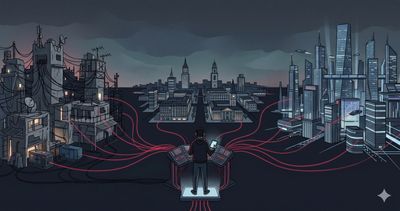
A career post-mortem on running three incompatible cultural stacks simultaneously. From the raw-metal chaos of Beirut startups and an economic collapse, to the clean microservice boundaries of Frankfurt, to the hyperfunded greenfield of the GCC, and the one protocol that keeps your internal routing stable across all three.
Protocols, Payloads, and the Refusal to Log Into Infrastructure That Is Not Your Own
In systems architecture, running the same application across different infrastructure stacks requires a deep understanding of environment variables. If you don't adjust your configuration, the system crashes.
The same rule applies to a career that crosses geographies. Moving between the Levant, Western Europe, and the GCC is not just a time zone change. Each region runs on a completely different set of protocols: how you communicate, how you handle risk, how human networks are structured.
What reads as "high performance" in one region triggers a fatal error in another. To stay functional as a global professional, you have to learn how to run conflicting cultural operating systems side by side without burning out your own circuits. My journey through these three systems ran through chaotic startups, late-night street food, an economic collapse, and an unforgettable 4K video stream.
The Levant: Running on Raw Metal (High Volatility, High Resilience)
Early professional life in the Levant comes with no corporate scaffolding. No standardized pipelines. No predictable infrastructure. You are running on raw metal.
When I co-founded my first startup straight out of my computer engineering studies, it was pure chaos. Nothing was standard. It was a constant cycle of shipping whatever code we had ready to keep the servers running. We eventually found some stability when we carved out a niche building CMS platforms for major radio networks across the region. That stability finally gave us the opportunity to grow up, to bridge from a scrappy startup into a real company. We just never took it. We stopped seeing eye to eye, and I walked away in search of something new.
That something new was Keeward. They sent me to Paris at 25, lit up my love for how Europeans work, and eventually ran out of runway, stopped paying salaries for six months, and shut down.
After Keeward, I joined a major retail giant to manage their e-commerce infrastructure and was handed a solo task: migrate the entire platform from Magento 1 to Magento 2, completely alone. Melissa, my then girlfriend and now my wife, used to meet me on Hamra Street at all sorts of godless hours for a quick bite, bringing snacks and little notes so I had something to look forward to before diving back into production. The only truly good thing that came out of that period was knowing she was the one.
Then Lebanon's macroeconomic collapse triggered a total system failure. My savings vanished overnight. What had been a genuinely good $5,000 USD salary started being paid in local currency, and hyperinflation knocked my purchasing power down to around $50 USD. The system forced a termination loop. I proposed to Melissa somewhere in the middle of all that chaos, because when everything is collapsing around you, you know fast who you want next to you. I secured a path to Germany. She relocated with her family to Saudi Arabia while we figured out the next move together.
And here is the paradox of the Levant: despite the godless hours, the toxic management, and everything collapsing around us, it was genuinely fun. We were happy. We went skiing, we traveled, we stayed out all night. Maybe it was a coping mechanism. Maybe the human middleware was just that resilient. Either way, we ran a high-joy background process right alongside a failing infrastructure. We simply forgot the madness outside the door and lived.
But the scars are real, and they do not fully go away. When the 25th falls on a Sunday and my salary does not land until Monday, I still feel it. A flash of panic, a tightening in the chest, even though I know it is just a weekend clearing delay and everything is fine. Or when my internet drops from 1 Gbps to 400 Mbps, a small part of my brain still braces for three days without a connection. Rationally I know these are ghosts. But the body remembers what the mind has moved on from.
⚡ The Takeaway
The Levant builds elite firefighters. It creates an engineering mindset that is hyper-adaptable and highly resourceful. But without an orchestration layer, the human cost of constant context-switching and toxic hierarchy eventually forces a system shutdown.
Western Europe: The Decoupled Microservice Framework
When I finally moved to Germany to join a major e-commerce company, the psychological relief was immediate. I still remember my first week in Frankfurt: waking up knowing the water would run, the electricity would stay on, and my salary would land on time, every time. The very first thing I did in my new apartment was stream a movie in glorious, unbuffered 4K. A simple data-throughput test that confirmed I had landed in a stable system.
The real cultural shock came later. In Western Europe, roles are tightly decoupled. Everyone has a clearly defined boundary, and they protect it without apology.
🛑 Protocol Mismatch: The After-Hours Error
During my first few weeks in Germany, my Levant-conditioned brain told me to answer a work email late at night to show dedication and avoid the risk of being yelled at. The next morning, HR promptly told me not to work after hours. Overworking was not logged as a badge of honor. It was flagged as a failure of resource scheduling and a violation of system boundaries.
Adapting to this took time. Coming from a world of constant firefighting, it felt genuinely strange to close my laptop at 5:00 PM or leave my work phone at home during vacation without having an anxiety spiral.
The GCC: The High-Velocity, Greenfield Scale-Up
The third region in this stack is the GCC, built around hyper-growth hubs like Riyadh and Jeddah. My wife was building her architectural career there, so learning to interface with this environment was not optional.
The GCC operates like a heavily funded greenfield scale-up. The budget feels unlimited, and companies want enterprise-grade infrastructure deployed overnight. But that ambition runs on top of deeply entrenched, top-down hierarchies. The culture rewards visible hustle, constant availability, and managing upward.
👔 Protocol Mismatch: The T-Shirt Incident
A friend based in Riyadh invited me to his office to explore working together. I showed up in a t-shirt. The look on his face told me everything. In the GCC corporate environment, appearance is part of the stack. How you dress, how you carry yourself, how visible your dedication is. These are not soft signals. They are performance metrics.
Beyond the dress code, the deeper shock was the rhythm. Phone calls from bosses at 4 or 5 in the morning are not an incident. They are the normal operating cadence. Constant availability is not a perk you offer, it is a baseline expectation. And underneath all that energy, the infrastructure is often surprisingly fragile: no formal contracts, no shared drives, no backups. Entire projects managed over WhatsApp threads. The ambition is real, but the architecture holding it together is held with duct tape.
Then there is the hierarchy. In the GCC, tasks are not tasks. They are orders. You do not push back, you do not flag a risk, and you certainly do not say no, even when you know something is wrong. Raising a concern is often read as insubordination rather than engineering judgment. You execute, you stay visible, and you keep your reservations to yourself.
The disconnect hits hard when you live between these two worlds. Your European firmware tells you to protect your focus and flag problems early. The GCC environment reads both as weakness, operating on the assumption that real professionals comply first and ask questions never.
Refactoring the Noise: The Ultimate Lifestyle Hack
Early in my cross-regional career, my instinct was to defend my choices. I would get genuinely angry when people called me lazy for closing my laptop at 5:00 PM, or greedy for asking for overtime pay. I wasted a lot of CPU cycles trying to explain a modern, balanced way of working to people running completely different societal code.
But trying to refactor an entire region's legacy mindset is a losing battle. The better path is a much simpler response protocol.
🔌 The Drop-Connection Protocol
When someone asks why you closed your laptop at 5:00 PM or turned off your phone on vacation, do not explain yourself. Look them in the eye, smile, and say "You're completely right." Then drop the connection. Return status
200 OKand move on. People who genuinely want to understand will ask real questions. People who do not are not owed your data.
The Northern Star: Root Certification
Real operational peace comes when you stop using external validation as your primary dashboard metric. Big personal disruptions have a way of clearing out the low-priority log files. When my father passed away, the background noise of corporate politics and cultural judgment lost all its power overnight. I stopped caring about the critics.
In a way, it was a long-deferred update. I grew up in Lebanon, but my father had worked all over Europe, Germany in particular, studied at a German school, and genuinely loved German engineering. I still remember the teary eyes when I told him I had a job offer there, that weird mix of proud and heartbroken that only a father watching his only son leave can pull off. He raised us with a European mindset from the very start. That was my original configuration file. My origin story, if you want one.
My dad is my Northern Star. A man of unbreakable faith and unshakeable moral clarity. He held a senior position at the national telecommunications company, watched colleagues make millions by compromising their integrity, and never took a cent that was not his. He would even pay out of pocket for things the company should have provided, because the alternative was letting his standards slip.
When he passed, the routing protocol he had installed in me throughout my childhood finally made sense. One I had spent years resisting without ever understanding why it mattered so much. But carrying that inheritance comes with weight. Now that I am a father myself, my biggest fear is not a failed deployment. It is whether I can pass that same clarity down to my own child, especially when he is constantly exposed to the exact opposite values.
In a world running on conflicting algorithms and compromised ethics, making sure his inner operating system is anchored to something solid is my ultimate life project.
As my dad always said: the most important architectural goal in life is to lay in bed at night with a clean conscience. Trust your own telemetry, hold your boundaries, return a cheerful 200 OK to the critics, and keep your core system safe.
Subscribe to Life in Production
New essays on engineering, career, and life. No spam, unsubscribe anytime.