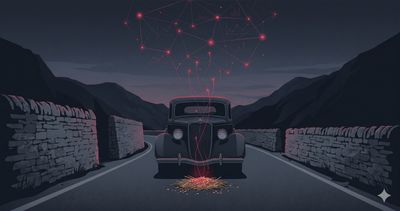
From hay left out for cars in a Lebanese village to an AI that cracked almost every classified system in hours, humans fear what they don't understand. The danger was never the technology. It was always the access policy built around it, and whether you showed up with a question or an answer.
My grandfather grew up in Ras Baalbeck, a small town in the Bekaa Valley of Lebanon. When cars first arrived in the village, people were afraid. Not in a vague, anxious way. In a specific, practical way. They left hay and grain in front of the cars at night. They didn't want the machines to go hungry and come after them.
He told me this when I was twelve or thirteen. I had just started getting into computers. I remember thinking: how could anyone believe a car needs to eat?
I have thought about that story a lot lately.
Human beings have always feared the things they don't understand. Fire, first. Then they learned to harness it, then to worship it. When cameras appeared in the nineteenth century, many people refused to be photographed. They believed the machine would capture their soul. When cars arrived in mountain villages across Lebanon, people left out hay.
Now it's AI. The fear is real. The understanding is thin. And the people loudest about the danger are often the ones who understand it least. Or the ones who understand it best and need you not to.
The Hay and the Keys
On June 11, 2026, Senator Mark Warner told a Senate committee that General Joshua Rudd, who runs the NSA and the Pentagon's Cyber Command, had briefed him on Anthropic's Mythos model. In Warner's recounting, it had "broken into almost all of our classified systems, not in weeks, but in hours."
Within a day, the line was everywhere, stripped to its scariest shape.
What the retelling dropped: the AI did this during authorized red-team testing. The NSA asked it to try. They handed it access. It succeeded. That's what red-teaming is for. Warner's own point was almost the opposite of the headline. He was relieved a capability like this sat with a company willing to test it before shipping. By the time the claim reached most people, that part was gone.
It's the same story as the hay. Nobody left it out for nothing. Someone opened the gate, gave the machine the keys, and then reported that the machine had moved on its own.
This is how technology fear has always worked. You strip out the human decision that came before the outcome. The fire burned the house. The camera stole the soul. The car came alive. The AI hacked us.
In each case, the actual chain of events started with a human hand.
I understand why the story lands differently without that context. "AI broke into NSA systems in hours" is terrifying. "AI succeeded at the task we explicitly authorized it to do" is a press release. But omitting the context isn't just bad communication. It's the hay. It's leaving out the part where you made the decision.
The danger was never the technology. It was the access policy built around it.
This is not the same as saying AI is safe. Atomic energy isn't dangerous because of physics. It's dangerous because of who holds the button. AI is the same, only more accessible than a nuclear facility by orders of magnitude. The access question just reaches more people, in more situations, with less oversight.
But the answer to that is not to fear the thing. It's to be serious about the access. And to educate. I knew at twelve that a car doesn't need to eat. Not because the fear was unreasonable. Because I learned what a car actually was. My grandfather's village wasn't naive. Knowledge doesn't reduce fear. It gives it meaning.
You should be afraid of AI the way you should be afraid of a car. Not because it might eat you. Because someone might drive it drunk. AI needs the same treatment. Not less regulation, not more panic. More understanding.
The Same Failure, Smaller
The same pattern shows up at the individual level, quieter.
A relative asked ChatGPT whether to visit Lebanon. They already knew what they wanted to do. They wanted to go. So they wrote: "I really want to visit but I'm worried about the situation. Should I go?"
ChatGPT told them to go. Here's how to stay safe. Here are the things to watch. Numbered list. Confident tone.
If they had written "I don't think it's safe right now, what do you think?" ChatGPT would have agreed with that too. Same model. Same data. Opposite answer.
This is not a bug. This is a feature. ChatGPT is not an oracle. It's a fortune teller. It tells you what you came to hear.
They gave the model access to their conclusion. It handed it back. They called it advice. Just like the NSA gave the model the keys to its systems, and the headline called the result a breach.
I've watched developers paste a Jira ticket into an AI coding tool (title, description, acceptance criteria), flip on auto-accept, and go make coffee. They come back. The code is there. Tests pass. They open a PR. No thinking happened. The model doesn't know the rest of the codebase, the edge case flagged in standup last Tuesday, or what the ticket is actually solving for. It had the ticket. It had the cursor. That's it. And when it breaks in production, they blame the AI.
At every level, from Senate hearings to pull requests, the failure is the same. People hand over access without thinking about what they're handing over. Then they're surprised by what comes back.
🎓 The Good Teacher Problem
A bad teacher hands you the answer. You write it down, pass the test, forget it by Tuesday. A good teacher makes you work for it, asks the question a different way, points at what you're missing, waits. You find it yourself, and that one sticks. AI, used well, is the good teacher: you bring a half-formed thought and ask it to push back. Most people just want the answer. They get it, they move on, no sharper than when they started. An answer without the question behind it is just noise dressed up as signal.
The Variable
My grandfather's village eventually learned what cars were. They figured out you don't feed them hay. You feed them petrol. You learn to drive. A generation later, they couldn't imagine life without them.
The fear didn't go anywhere. It just got smaller than the usefulness.
That's probably where we end up with AI. The question is what we do between now and then. Whether we use the fear to demand backdoor access and call it safety. Whether we use the tool to confirm what we already believe and call it research. Whether we hand over the ticket and call it engineering.
Or whether we treat access as the serious question it has always been. Who gets it. What context they bring. What they do with what comes back.
That was the question with fire. With cameras. With cars in Ras Baalbeck.
It's still the question.
Back to Life in Production